Retrace
Timeline
3. Semester at Uni - 2024
Tools and Skills
User Centred Design, Figma, Illustrator
Type
Concept Work, Interaction Design
Introduction
14 Million Europeans are currently suffering from dementia. It is an umbrella term for a great number of symptoms related to the loss of cognitive abilities. The disease leads to varied impairments in the quality of life of both the patient and the people around them. Supporting people with dementia - that was the theme of a project during my studies. In a team of three we developed a concept for a product in that area.
Retrace is a three part tracking system both accessible for older people and highly customizable for the caregivers around them.
Empathize with users
Starting this project, none of us had a good grasp of dementia. To learn more we took a three step approach consulting different sources to understand the reality of people with and around dementia.
Research (papers - statistics - literature)
Firstly, we took to literature to learn about the fundamentals surrounding dementia. There is a plethora of organisations trying to educate people about the disease, often telling differing and sometimes conflicting information.
Dementia is an umbrella term for many diseases, all with different causes, symptoms and effects. We tried to focus our efforts on Alzheimer's disease, the most common cause for dementia with 60 to 80 percent of all cases.
Interviews (relatives - caregiver)
With our acquired knowledge we talked with people working with dementia.
One is a nurse working in a retirement home. According to her, most seniors living there have some stage of dementia. She described a range of effects dementia can have on people and how caregivers learn to adapt to their patients wants and needs. We would go on and consult her again in different stages of this project.
Other people were relatives of dementia patient. They described the everyday struggle and mental strain connected to having a relative with dementia. These stories helped humanize these people and gave ample inspiration for Retrace.
[The patients] sit in front of the prepared sandwich they made themselves and don't know how to put it into their mouth.~ Quote from the nurse we interviewed (translated from German)
Expert opinion
The finishing touch to our research was a presentation by a representative of the "Alzheimer Gesellschaft Ingolstadt" (Alzheimers' association Ingolstadt), Mrs. Stampfer. She confirmed many facts we read and heard about before, but also gave insights into ways to deal with dementia as a caregiver and relative. We learned best practices and common pitfalls we later implemented into the final product.
Key insights
Diversity:There is no typical dementia patient. Symptoms and progression greatly vary from patient to patient.
Shame:Many patients with early stage dementia are ashamed of their condition and try to hide their struggles.
Strain:Dementia puts a strain on not just the patient, but also their relatives and their relationships. They should also be considered.
Technology:People with dementia and their imitate surroundings are often not very good with newer technology.
Define Requirements
Concept
Using our research we developed multiple concepts we could peruse going forward. We decided on a tracking system for three key reasons:
Not just digital, not just physical
Retrace has both a physical and digital interface. The module itself focused on digital application but according to our research, physical interfaces would be more accessible to older people for a variety of reasons.
Uncommon concept
Our course had over 20 teams working on the central theme of supporting people with dementia. Some ideas are bound to be similar. We continuously choose a concept that was out of the ordinary to not (unintentionally) copy ideas or spark any form of competition.
United Vision
As a group we need a united understanding of our central concept, its use cases and strengths. Most of that comes down to feeling. It was clear early that we were most passionate about Retrace out of all our ideas.
Business Problem
We found out that people with dementia often misplace items. Connected to that is the tendency in some patients to hide important or trivial items from those around them. We want to expand on existing tracking systems in multiple ways. The first is by making the trackers work like pagers when activated, aiding in the search of nearby items. The second is giving dementia patients a physical interface through haptic buttons, since their often struggle with digital mediums.
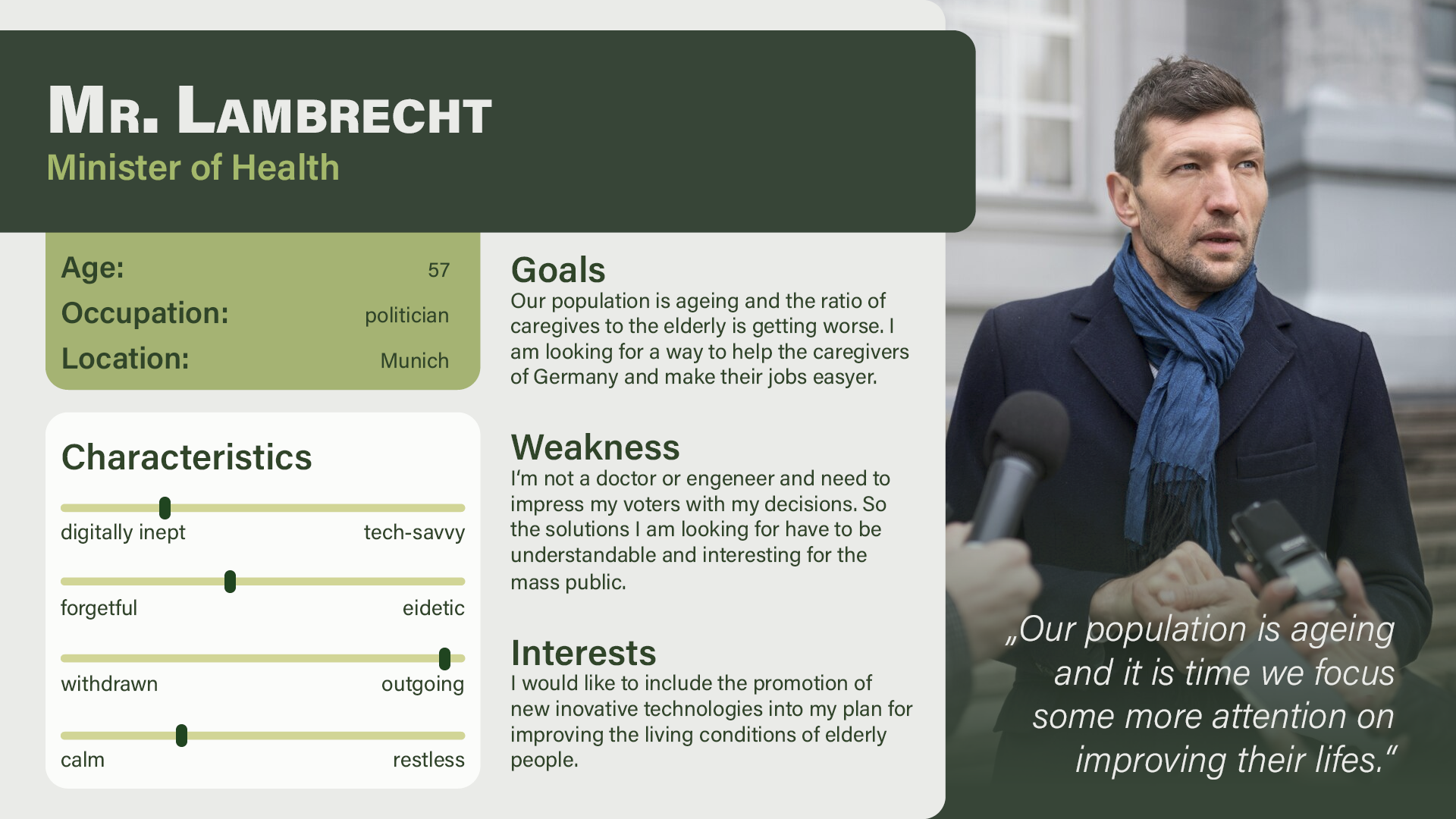
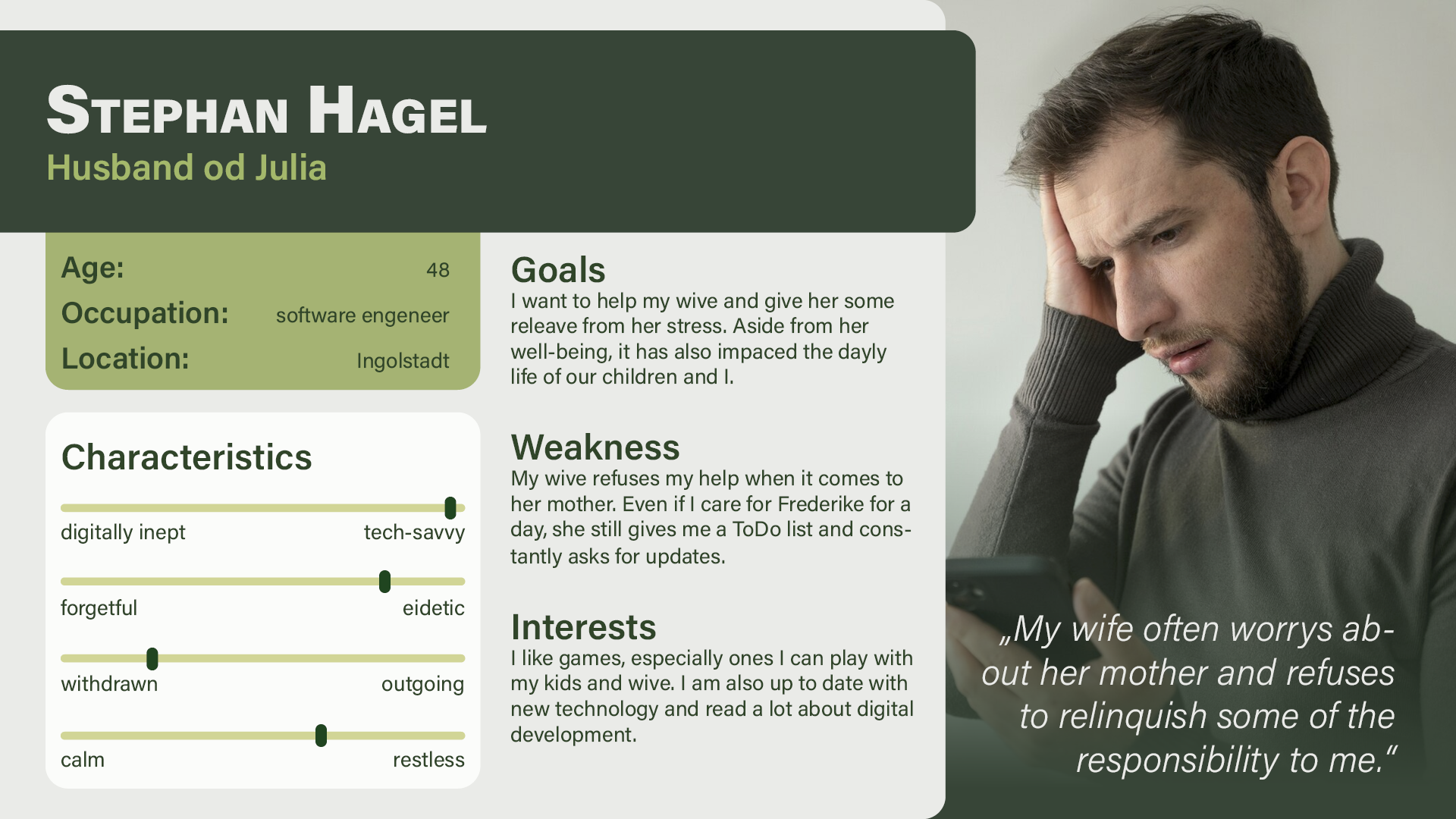
Personas
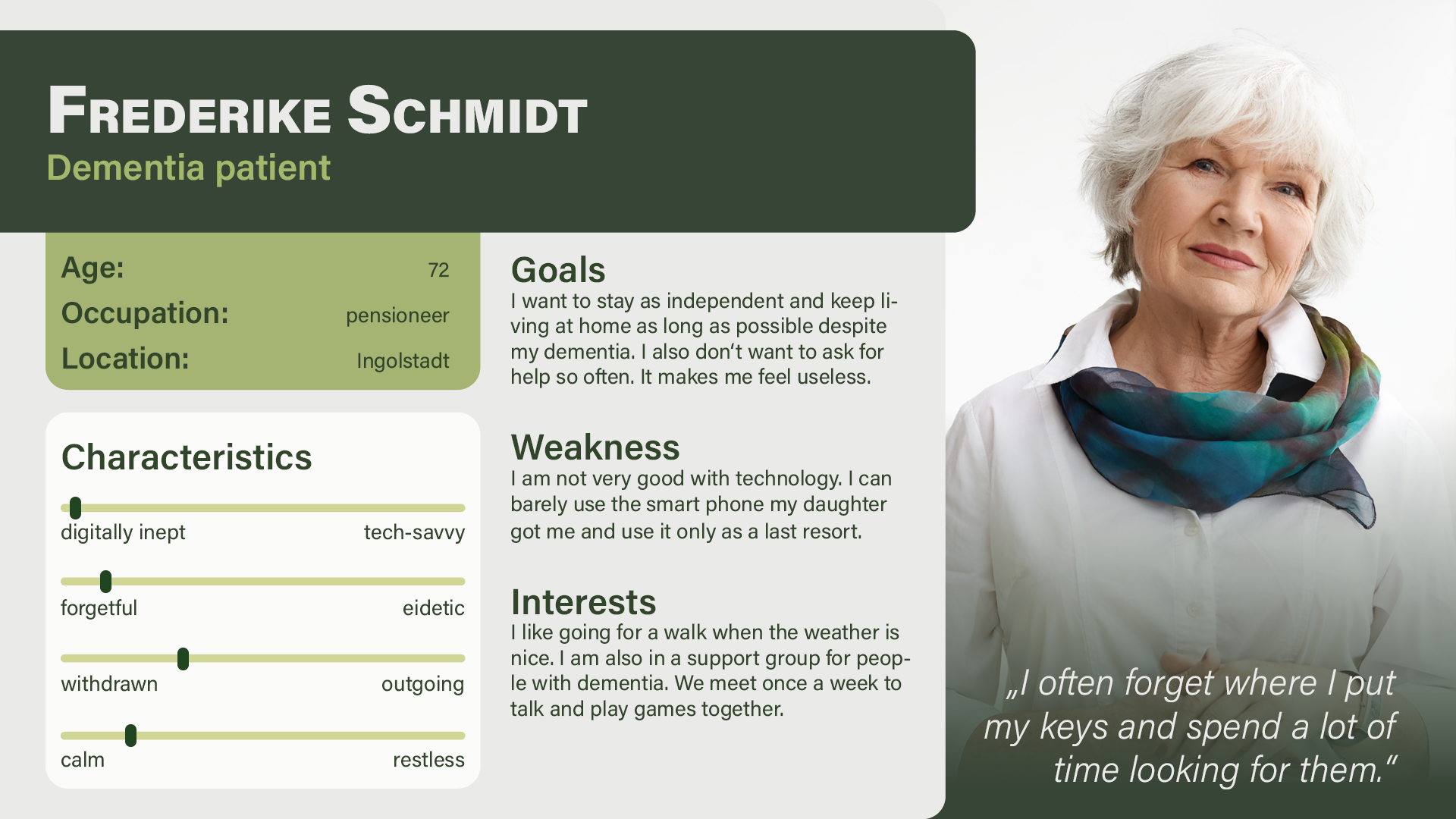
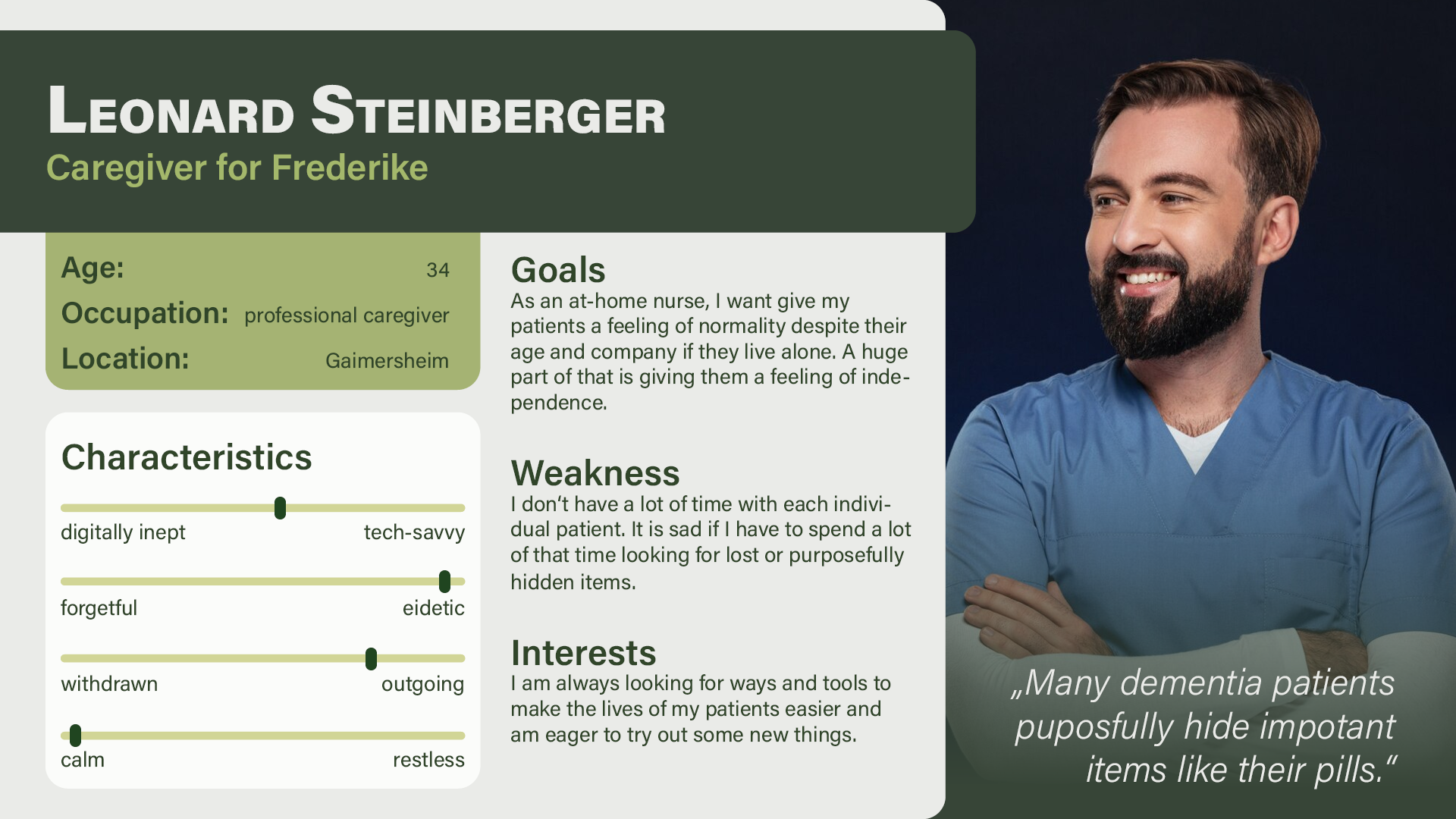
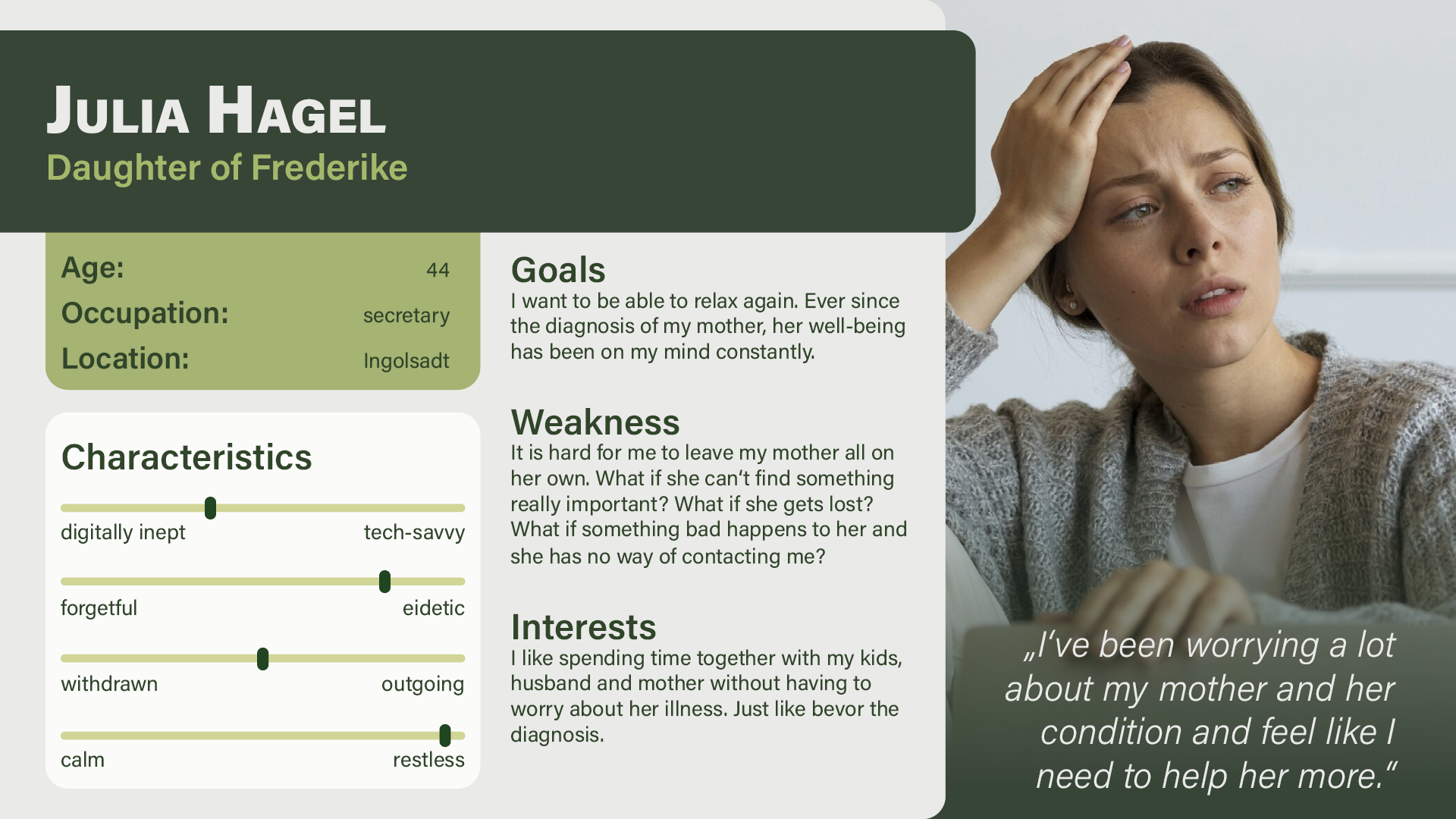
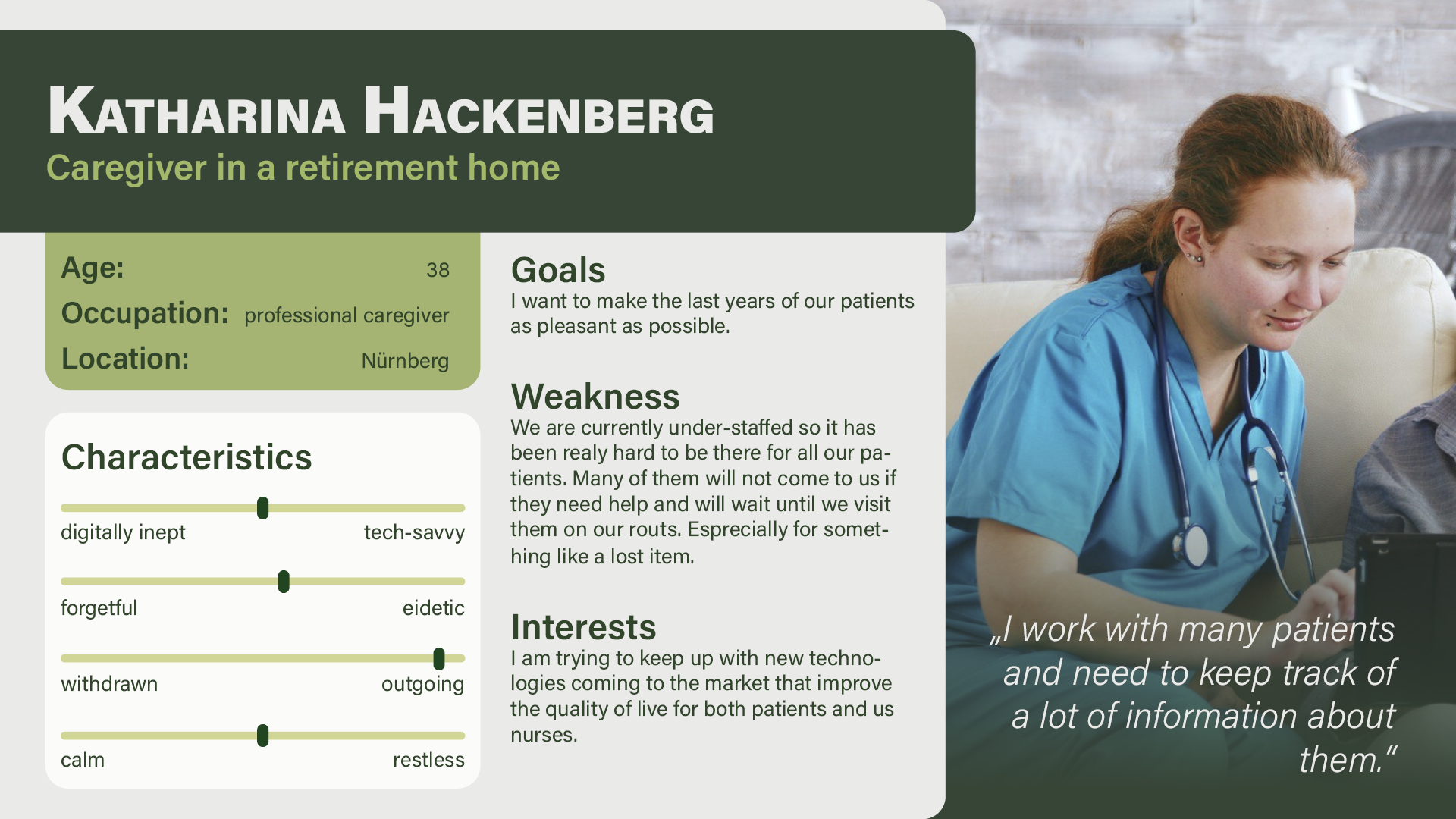
We created a total of 6to better understand the wants and needs of different users. Using their perspective we gathered our initial requirements for Retrace.
Ideate
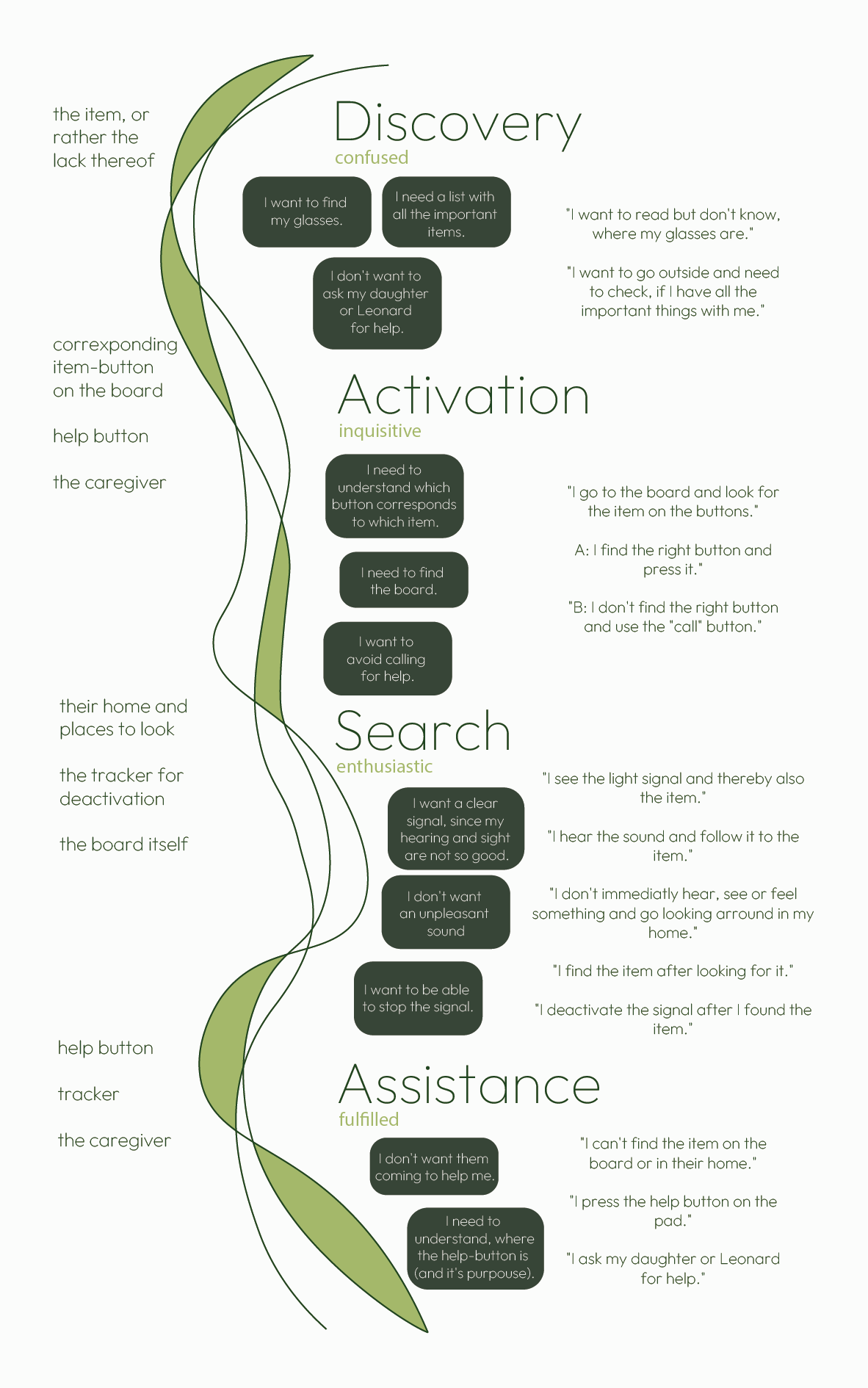
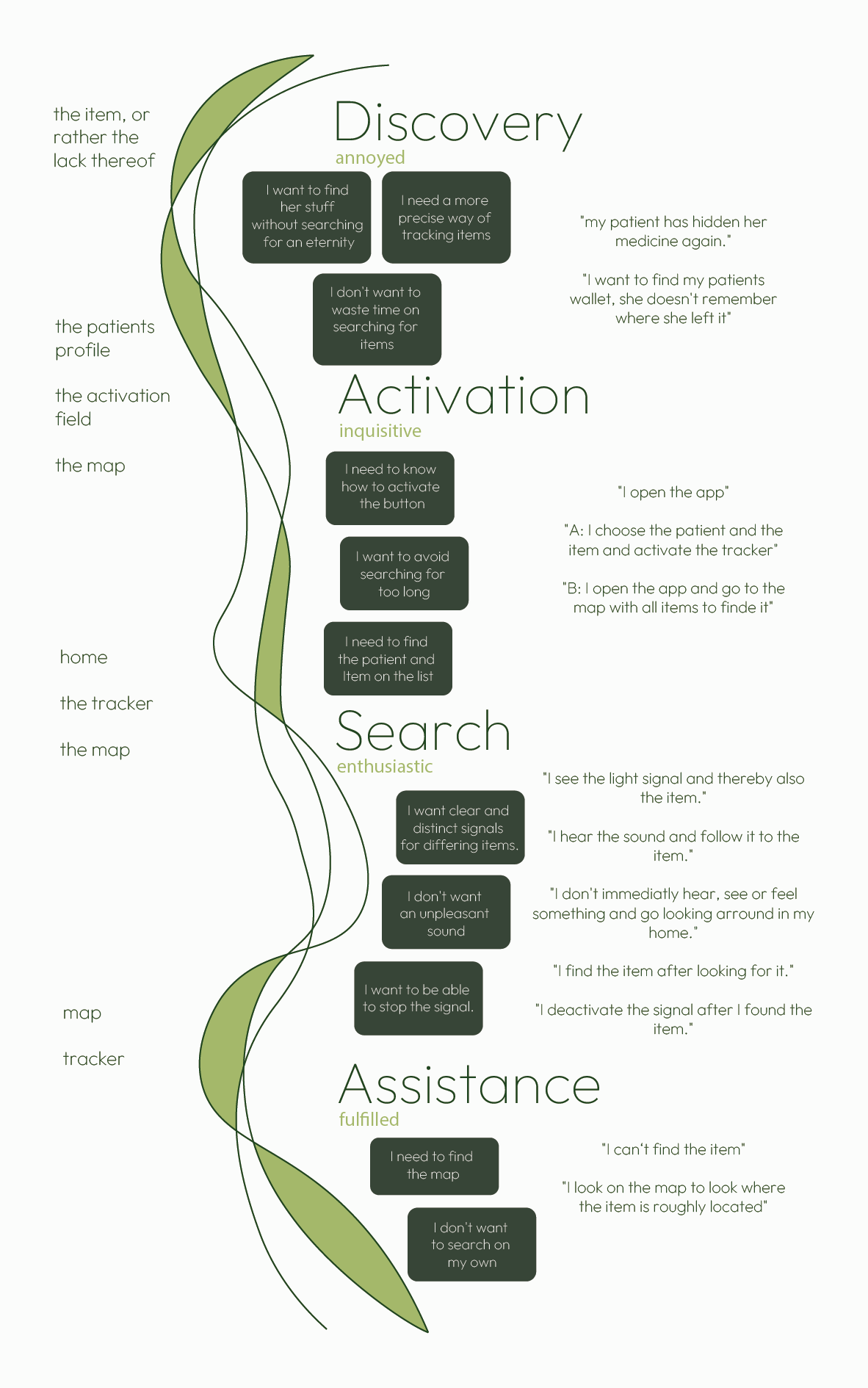
User Journeys
We created twofor our two primary users: a patient and a nurse.
User Journeys for a patient:
User Journeys for a caregiver:
Key Insights
Using our User Journeys we collected Key Requirements Retrace needed to cover:
having an overview of all items connected to a Retrace system
a way to activate a tracker through the app
having GPS-location of all trackers in the app
being able to change the type of signal of a tracker to the needs of a patient
customizing the location of items/ trackers on the physical board through the app
connecting a new item/ tracker or patient (only for institutions)
Wireframes
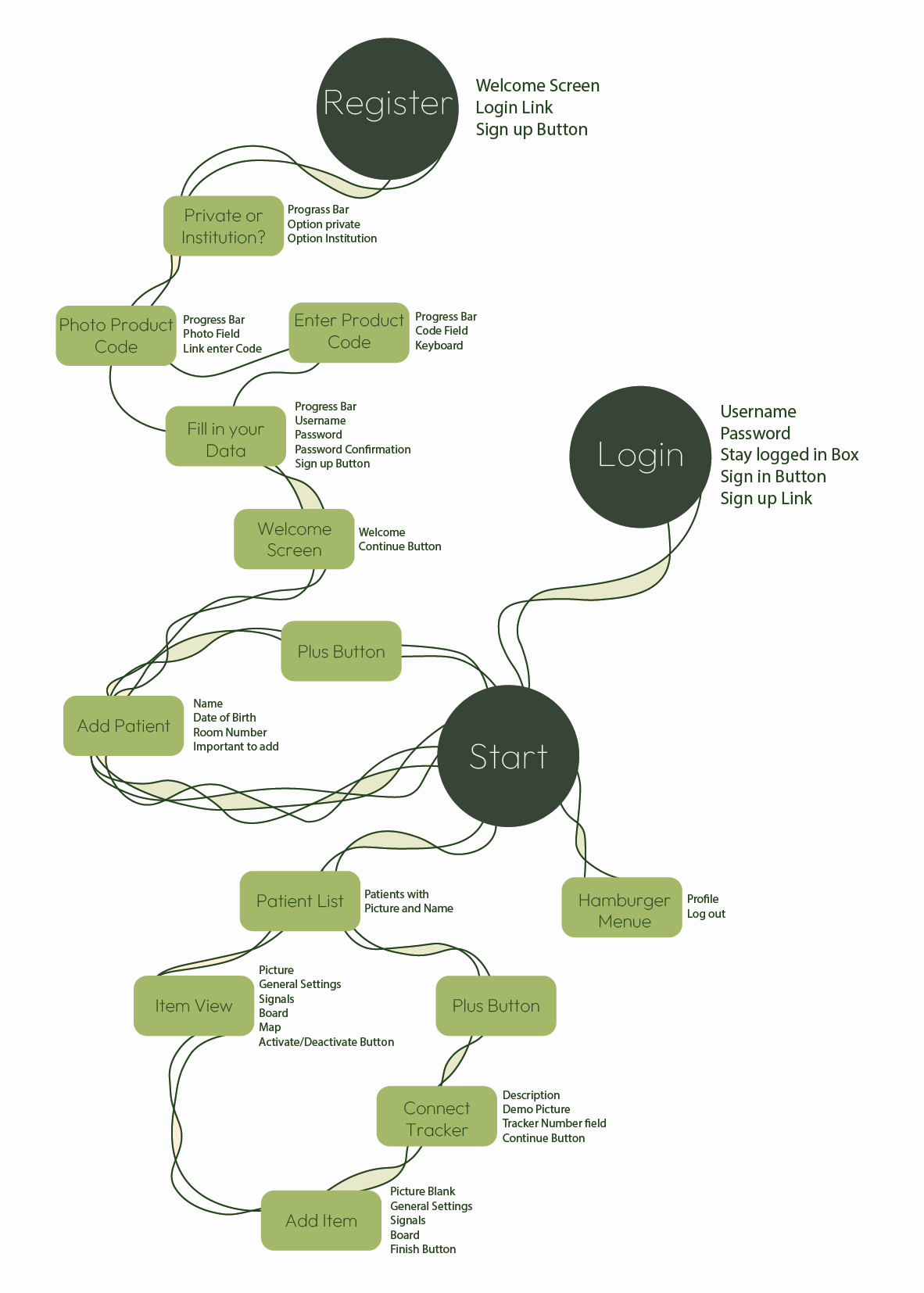
With our list of features we created twosystems, one for privat users, one for institutions. The main difference is that institutions need to keep track of multiple patients, each with their own system of items. Privat user only have one patient and therefore do not need an overview of patient profiles.
Prototype and Testing
Paper Prototype
Using our Wireframes we created a first Paper Prototype to test the navigation between, arrangement of and interaction with elements on different screens.
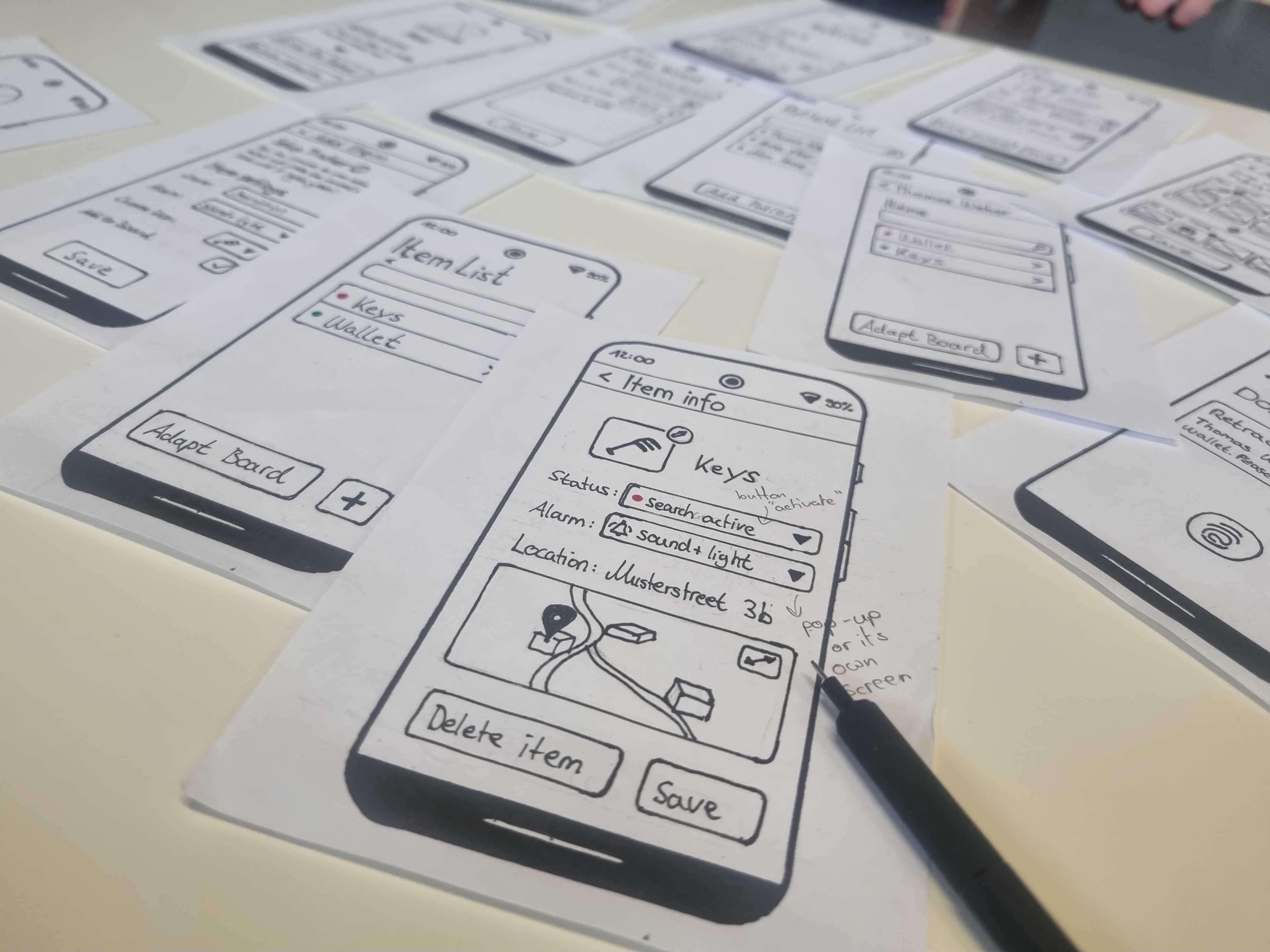
Some feedback we got through testing was:
The registration process is too complex for one screen. We ended up with a three-step registration process that changes based on if the user is an institution or a privat user.
Items were originally represented by icons. Most testers agreed pictures would be more intuitive.
For context: Most screens have a larger button on the bottom for various purposes. Sometimes there would be a second one next to it, changing the buttons size and location. For the sake of continuity the button should now be in the same location on every screen and secondary buttons would be located elsewhere.
Detail screens for individual items were unintuitive and incomplete. For example, a user could activate or deactivate the tag remotely only through a dropdown menu.
Digital Prototype
We implemented the feedback into our first clickable prototype in Figma. This prototype went into a second round of testing.
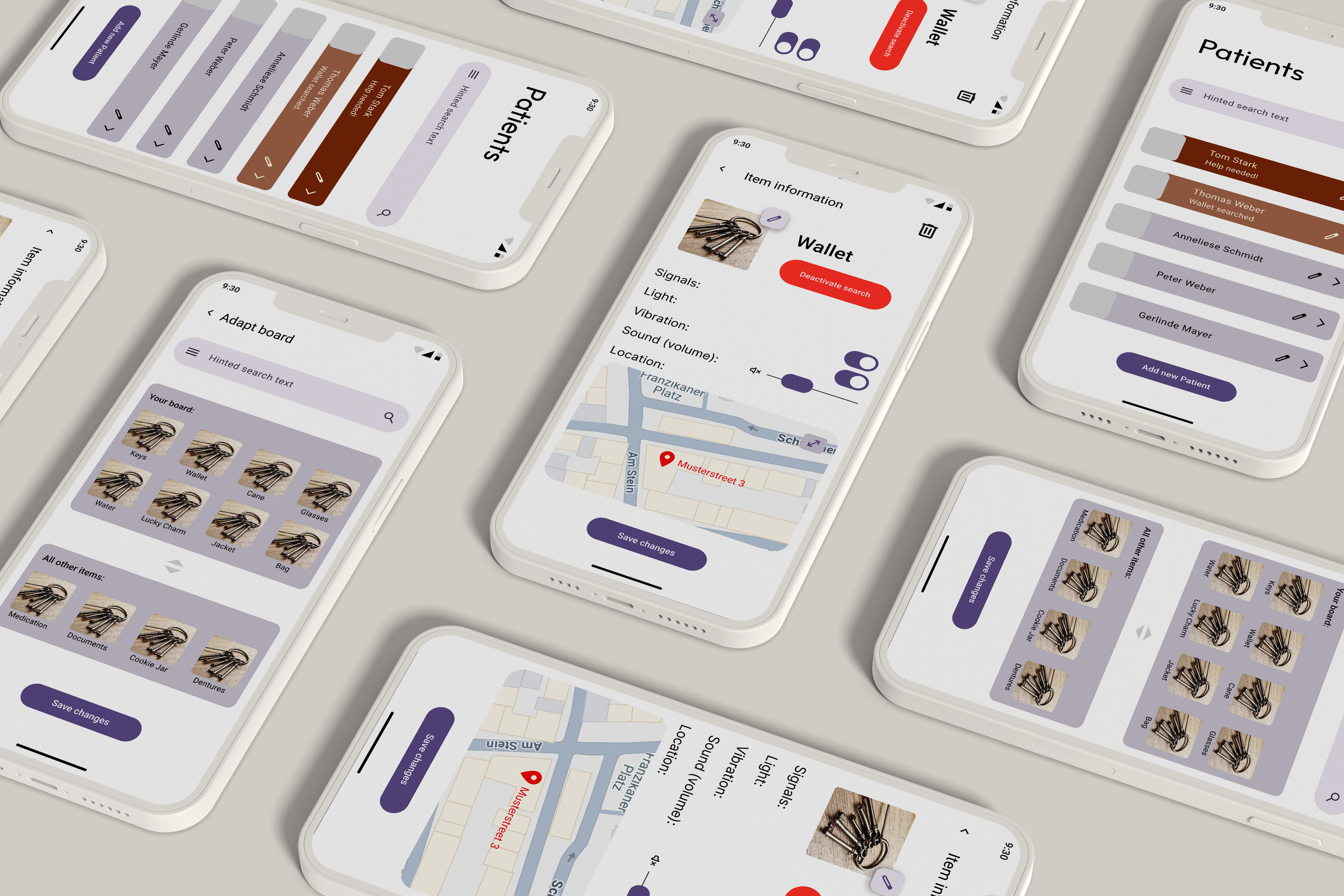
We got some more feedback this time around. For example, the Home Screen did not feel like such. We needed to distinguish it further from other screens. In addition, most people wanted to edit the location of an item on the physical board through the item detail screen, a feature we later added. We also overlooked entire functions. To name one: While user created an account at the registration, there was no way to edit this account or log out.
Designing the App
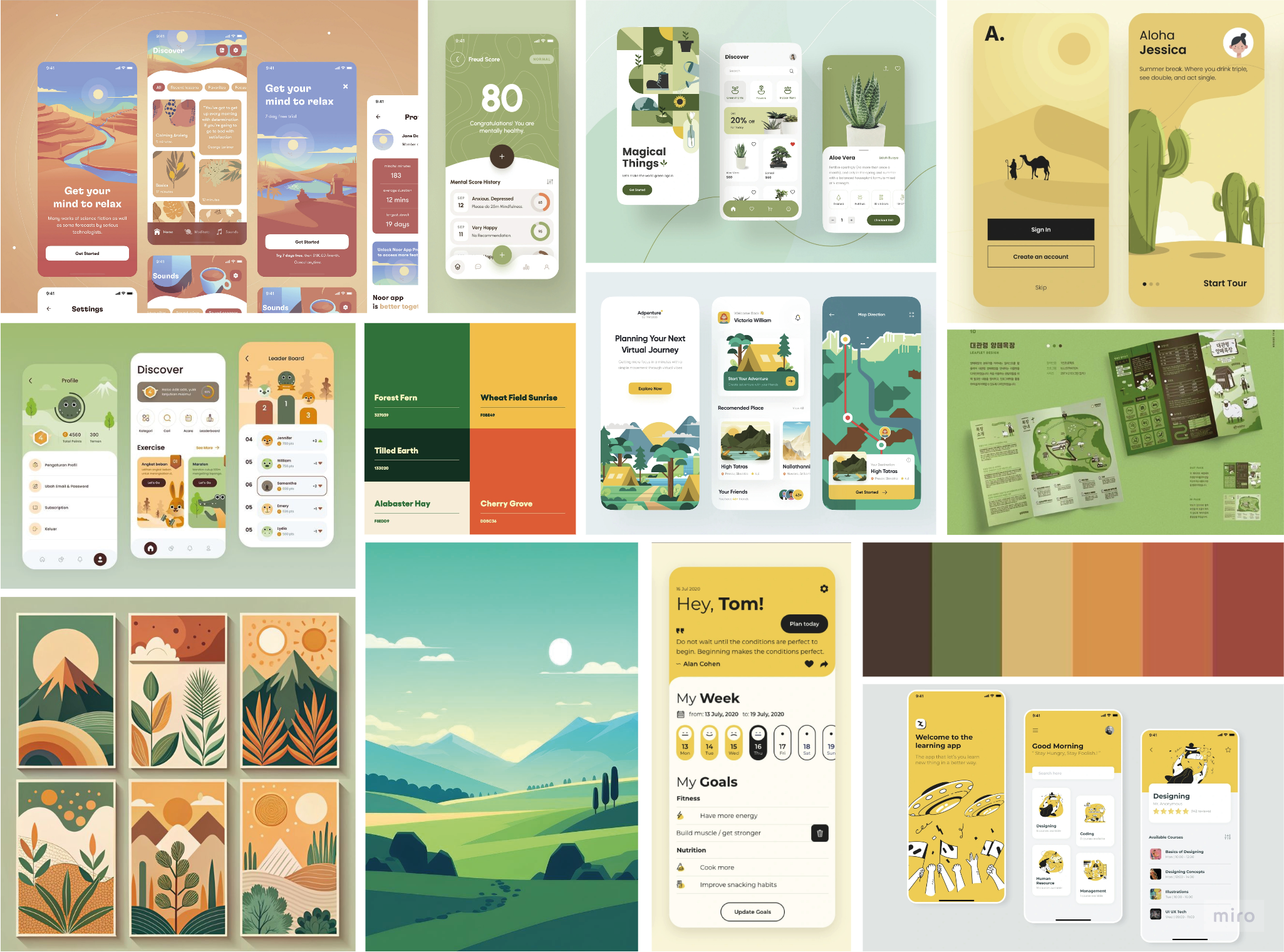
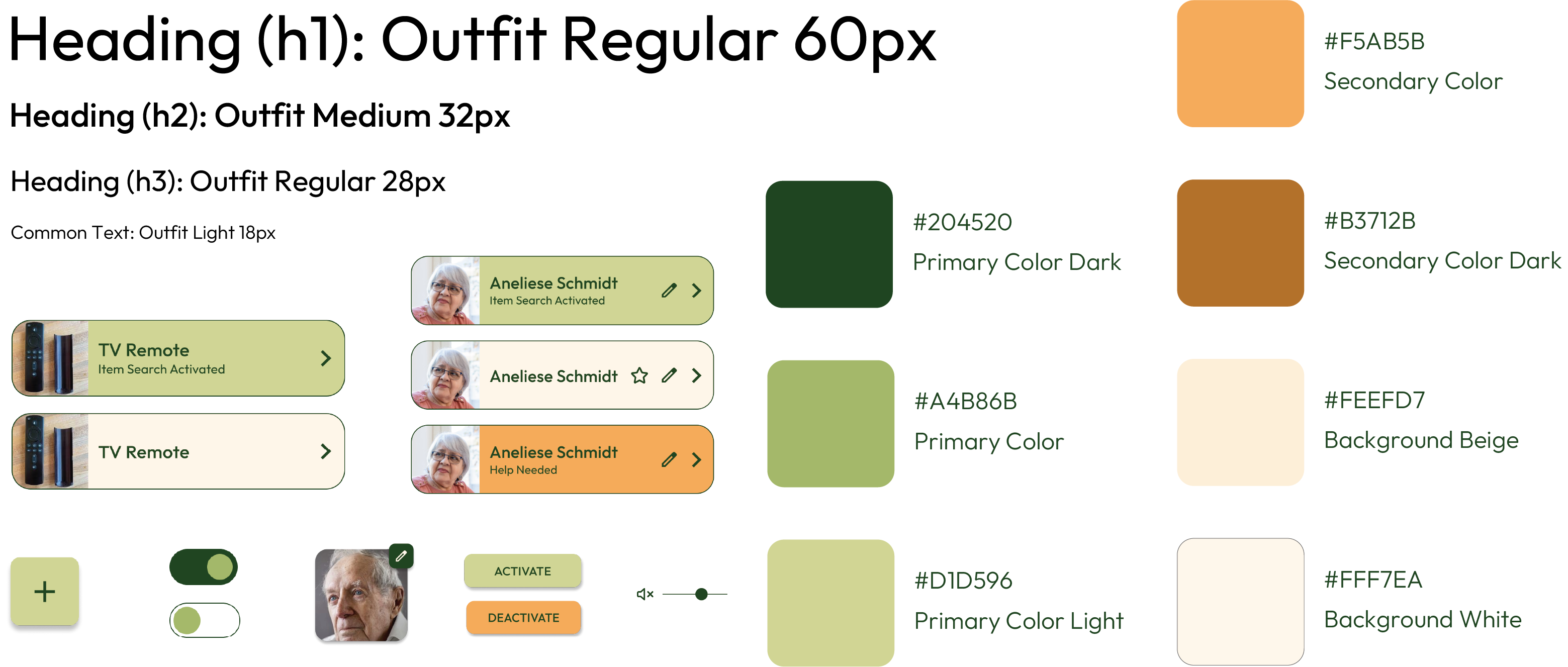
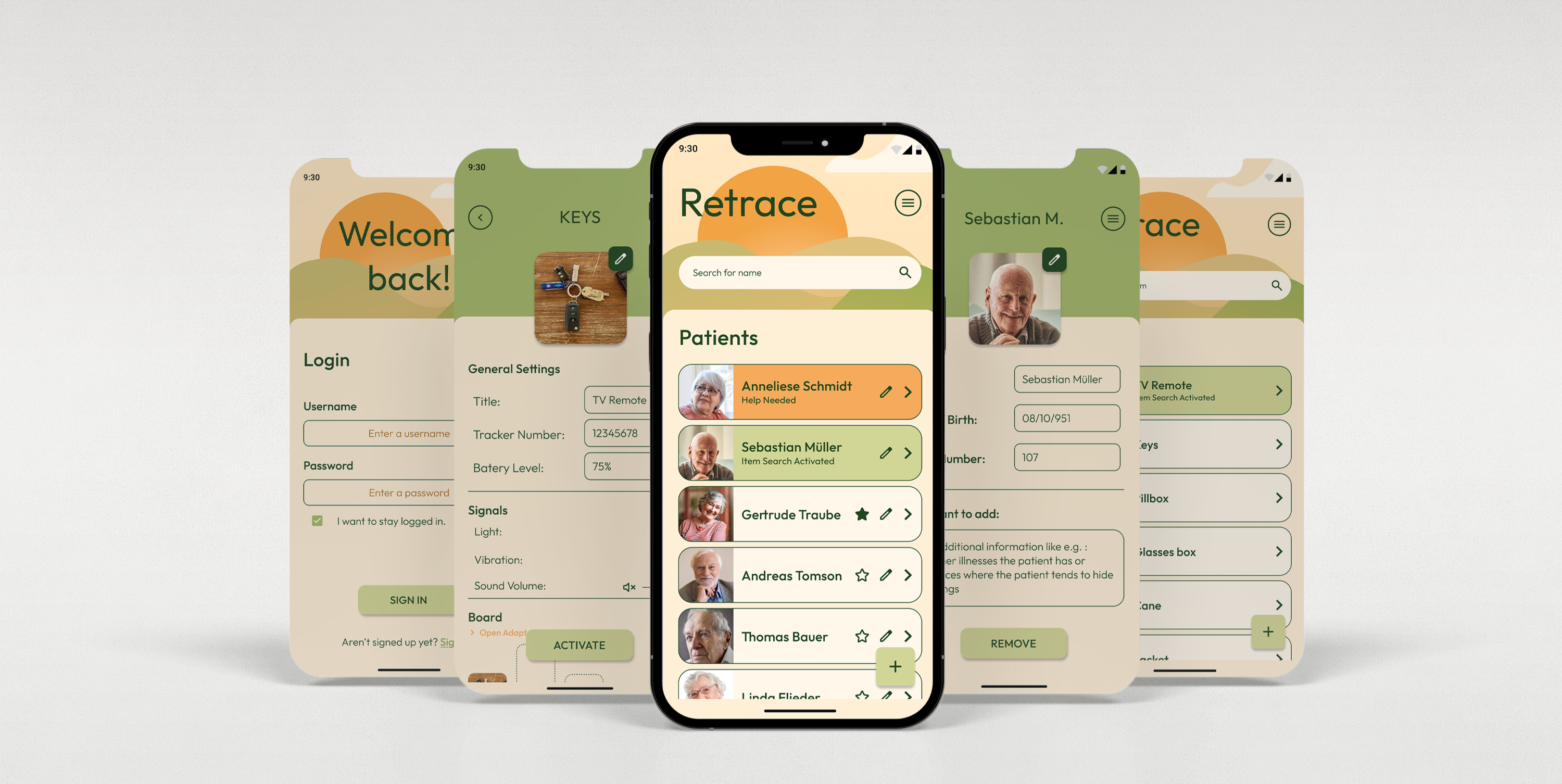
The next step was designing Retrace. We wanted the app to feel warm and welcoming.
Moodboard
Styleguide
High-Fidelity Prototype
This concept work ends with a Figma Prototype. Click hereto explore it some more.
Reflections
Retrace was a great opportunity to use a myriad of skills we had aquired through other courses and smaller works. It was up to this point the largest project of our studies in scope and time spend. Not mentioned so far were physical prototypes for both the board and tag mostly created by my teammates throughout this project. While I did partake in the ideation-phase, my focus in the latter half was the app.
A part of this course was a final presentation of every group project. Among the many guests was Mrs. Stampfer (the representative of the "Alzheimer Gesellschaft Ingolstadt"). She was a partner of this course and asked to use the projects of this course at conferences and seminars. There, they may serve as inspiration for future projects with the purpose of supporting people with dementia.